
Why Tri-Cities Homeowners Are Choosing Composite Decks
If you’ve been thinking about adding a porch to your home or replacing an aging one, you’ve probably noticed how many homeowners across the Tri-Cities are moving away from traditional wood and toward composite decking materials. There’s a good reason for that — and it comes down to how East Tennessee’s climate treats the materials you build with.
As a porch builder and deck contractor serving Johnson City, Kingsport, Bristol, and the surrounding Tri-Cities area, we see firsthand what happens to outdoor structures in our humidity, temperature swings, and storm seasons. This post breaks down why composite decking has become the go-to choice for porch and deck projects in East Tennessee — and what to look for when choosing a porch builder for your project.
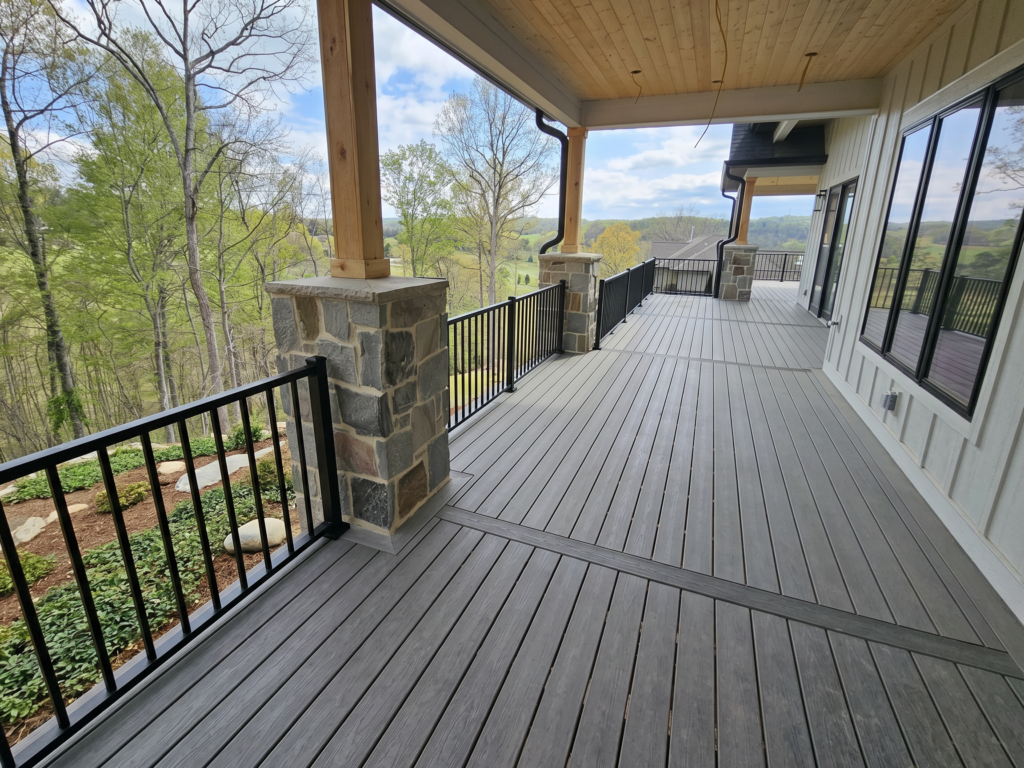
What Makes East Tennessee Hard on Porches and Decks
The Tri-Cities sits in a climate zone that throws everything at your outdoor living space. Summers bring sustained heat and humidity levels that promote mold, mildew, and fungal growth on wood surfaces. Winters bring freezing temperatures that cause wood to contract, crack, and split — especially after absorbing moisture during the wetter months. Spring and fall bring thunderstorms with high winds and hail that test every fastener and connection.
This cycle repeats year after year. For a wood porch or deck, that means annual staining, sealing, and board replacement just to keep the structure functional and safe. For homeowners in Johnson City’s sloped neighborhoods, Kingsport’s established communities, and Bristol’s larger rural lots, outdoor maintenance is already a long list — and a high-maintenance porch adds to it every season.
This is the core reason composite decking has taken off in the Tri-Cities. It’s engineered specifically to handle the conditions that destroy wood over time.
Learn more about our → deck building services in the Tri-Cities
What Is Composite Decking — And Why Does It Work for Porches?
Composite decking is manufactured from a blend of recycled wood fibers and plastic polymers. The result is a board that looks and feels like wood but performs dramatically better in moisture-heavy, high-UV environments like East Tennessee.
Most modern composite products — including brands like Trex and TimberTech — use a capping technology that wraps the core material in a protective polymer shell. This cap is what gives composite its resistance to moisture absorption, mold growth, UV fading, and insect damage. It’s also what eliminates the need for annual staining and sealing.
For porches specifically, composite is a strong choice because porches take more direct weather exposure than many other parts of your home. A front porch faces rain, sun, and foot traffic every day. A back porch or screened porch in the Tri-Cities deals with humidity, pollen, and seasonal debris. Composite handles all of it with minimal upkeep — an occasional cleaning with soap and water is all most homeowners need to do.
Trex composite decking product details →
TimberTech composite decking →
Composite Deck vs. Wood Porch: The Real Cost Comparison
The number-one hesitation homeowners have about composite is the upfront cost. And it’s a fair concern — composite materials typically cost 2 to 3 times more than pressure-treated lumber. For a standard porch or deck project in the Tri-Cities, that might mean the difference between a $7,000 wood build and a $15,000 composite build.
But the real comparison isn’t about upfront cost alone. It’s about what you spend over the next 10, 15, and 20 years.
A pressure-treated wood porch in Johnson City, Kingsport, or Bristol needs maintenance every 1 to 2 years — cleaning, staining, and sealing. That runs roughly $300 to $800 per service depending on the porch size. Over 20 years, you’re looking at $3,000 to $8,000 in maintenance costs alone, plus the inevitable board replacements when wood warps, rots, or splinters. Factor in your time — entire weekends spent sanding, staining, and waiting for coats to dry.
A composite porch needs a soap-and-water cleaning once or twice a year. That’s it. No staining. No sealing. No sanding. No board replacements due to rot. Over a 25 to 50 year manufacturer-warranted lifespan, the total cost of ownership often ends up lower than wood — and you get all those weekends back.
See our → siding installation services — we handle full exterior projects
What to Look for in a Porch Builder in the Tri-Cities
Not all porch builders are equal — and the quality of the installation matters as much as the material you choose. A poorly installed composite porch can develop issues just like a wood one. Here’s what to look for when hiring a porch builder in Johnson City, Kingsport, Bristol, or anywhere in East Tennessee:
They Should Know Local Building Codes
Porch and deck projects in the Tri-Cities require building permits in most jurisdictions. Johnson City handles permits through the Building Inspections Department. Kingsport goes through the Department of Planning and Community Development. Bristol uses the Bristol Tennessee Building Inspections office. A qualified porch builder should know which department handles your permit, what’s required, and should manage the process for you.
See our → Johnson City service area page for local permit details
They Should Follow Manufacturer Installation Specs
Composite decking manufacturers like Trex and TimberTech have specific installation requirements — fastener types, board spacing, joist spacing, ventilation underneath, and end-cut sealing. These specs exist because composite materials expand and contract differently than wood. If your porch builder doesn’t follow these specs, your manufacturer warranty could be voided before you even use the porch.
They Should Be Insured
Any porch builder working on your property should carry general liability insurance. Ask for a certificate of insurance before work starts. If a contractor can’t provide one, that’s a red flag.
They Should Provide a Written Estimate
A professional porch builder will come to your property, take measurements, discuss your project, and give you a detailed written estimate — not a verbal quote or a vague range. The estimate should itemize materials, labor, permits, and timeline so you know exactly what you’re paying for before you sign anything.
→ Contact us for a free on-site estimate
Popular Composite Porch and Deck Styles in the Tri-Cities
Every property is different, and the Tri-Cities has a wide range of lot types — from the sloped yards in Johnson City’s north side to the flat, spacious lots in Bristol and the mixed terrain around Kingsport. Here are the porch and deck styles we build most often with composite materials:
Front Porches
A composite front porch gives your home an upgraded look that lasts. Composite boards are available in colors and grain patterns that look like natural hardwood — without the maintenance. For Johnson City and Jonesborough homes, a well-designed front porch adds curb appeal and functional outdoor space without the annual staining commitment that comes with wood.
Back Porches and Raised Decks
Many Tri-Cities homes sit on sloped lots, making raised back porches and elevated decks a natural fit. Composite is especially valuable on raised structures because the underside of the decking is exposed to moisture from below — a condition that accelerates rot in wood but doesn’t affect composite. We build raised composite porches and decks with proper ventilation and drainage to maximize the material’s lifespan.
Screened Porches
Screened porches are hugely popular across the Tri-Cities — and for good reason. They let you enjoy East Tennessee evenings without the mosquitoes and gnats that come out at dusk in the river valleys. A composite floor in a screened porch handles the trapped humidity and reduced airflow better than wood, and it won’t splinter under bare feet.
Wraparound Porches
A wraparound porch makes a statement, and composite makes it practical. Wood wraparound porches in the Tri-Cities require significant maintenance because of the large surface area exposed to sun, rain, and temperature swings. Composite eliminates that burden while maintaining the aesthetic homeowners want.
How Much Does a Composite Porch Cost in Johnson City, Kingsport, or Bristol?
Composite porch and deck costs in the Tri-Cities area generally fall in these ranges:
A standard composite porch (200–400 sq ft) typically runs $12,000 to $25,000 depending on size, elevation, railing style, and features. A larger composite deck or multi-level build ranges from $20,000 to $35,000 or more. Pressure-treated wood porches of similar size typically run $5,000 to $15,000 — but remember to factor in 20+ years of annual maintenance costs when comparing.
These ranges are general estimates for the Tri-Cities market. Your actual cost depends on your specific property, lot conditions, material selection, and project features. The best way to get accurate pricing is a free on-site estimate where we measure your property and discuss your project in detail.
Maintaining Your Composite Porch in East Tennessee
One of the biggest advantages of composite is how little maintenance it requires — but “low maintenance” doesn’t mean “no maintenance.” Here’s what we recommend for Tri-Cities homeowners:
Clean the surface twice a year with soap and water. A soft-bristle brush and a garden hose work fine. You can use a pressure washer on a low setting (under 1,500 PSI) but keep the nozzle at least 8 inches from the surface and use a fan tip — never a zero-degree tip.
Clear debris regularly. Leaves, pollen, and pine needles are constant in East Tennessee. If organic debris sits on the surface for extended periods, it can cause surface staining that’s harder to remove later. A quick sweep or leaf blower session every couple of weeks during fall and spring prevents buildup.
Check the gaps between boards. Composite boards are installed with spacing to allow for expansion and drainage. If debris gets packed into these gaps, it can restrict water flow and trap moisture against the boards. Clear the gaps during your regular cleaning.
That’s it. No staining. No sealing. No sanding. No replacing rotted boards. Just keep it clean and the material does the rest.
Trex composite deck cleaning guide →
Why I & G Construction Services Is the Porch Builder Tri-Cities Homeowners Trust
We’re a locally owned porch builder and deck contractor based in Johnson City, serving homeowners across the Tri-Cities — including Kingsport, Bristol, Jonesborough, Elizabethton, Gray, Piney Flats, and surrounding communities. We specialize in two things: building decks and installing siding. That focus means we’re not a jack-of-all-trades contractor — we’re specialists who build outdoor structures and protect home exteriors every day.
We install Trex, TimberTech, and other leading composite brands to manufacturer specifications, and we handle the full permit process with your local building department — whether that’s Johnson City, Kingsport, Bristol, or any of the county building departments across our service area.
Fully insured. No subcontractors. Our crew handles your project from start to finish. And every project starts with a free on-site estimate — no obligation, no pressure.
→ About I & G Construction Services
Composite Porch & Deck FAQ for Tri-Cities Homeowners
Most composite products are backed by manufacturer warranties of 25 to 50 years. With proper installation and basic cleaning, a composite porch in the Tri-Cities should easily last 25+ years without any board replacement, staining, or structural maintenance.
Darker composite colors can retain heat on full-sun days. Lighter colors and newer “cool-touch” product lines stay significantly cooler. If your porch is in direct southern exposure, we can recommend lighter color options or covered porch designs that mitigate heat. Screened or covered porches largely eliminate this concern.
In most cases, yes. Porch and deck construction typically requires a building permit — especially if the structure is attached to the house, over 30 inches above grade, or larger than 200 square feet. Each city has its own building department, and we handle the full permit process for you regardless of jurisdiction.
In some cases, yes — if the existing framing is structurally sound and meets current code requirements. We inspect the existing structure during our free estimate and let you know if re-decking over the current frame is viable or if new framing is needed. Composite boards require specific joist spacing (typically 16 inches on center or less) that older wood frames may not meet.
The terms are often used interchangeably, but generally a porch is attached to the home and has a roof or cover overhead, while a deck is an open, uncovered platform. Both can be built with composite or wood materials. A screened porch adds screen walls for insect protection. We build all variations across the Tri-Cities area.